
Tourism Policy · Türkiye · Destination Development
Cappadocia was not discovered. It was built.
A rural province in central Anatolia now draws more visitors to its museums than most European capitals draw to theirs. The landscape did not change. The institutions around it did.
Türkiye created a single national promotion agency in 2019 and gave it the mandate, and the funding, to build a brand.
Ballooning in Cappadocia is licensed commercial aviation with capped daily flights, not an adventure activity.
Cappadocia’s largest source countries now include China, South Korea, Japan, Taiwan and Brazil, not only European neighbours.
Every destination has a landscape. What separates the ones that grow is whether somebody built a system around it.
— Bourbiza Mohamed, Founder and Editorial Director, Euro News AgencyFirst published in May 2026 as a field note on travel photography in Cappadocia. Rewritten on 31 August 2026 as an analysis of how Türkiye developed the region, with 2025 visitor data, aviation figures and original field footage added. The original photography notes are no longer part of this article.
Let me tell you what that photograph does not show.
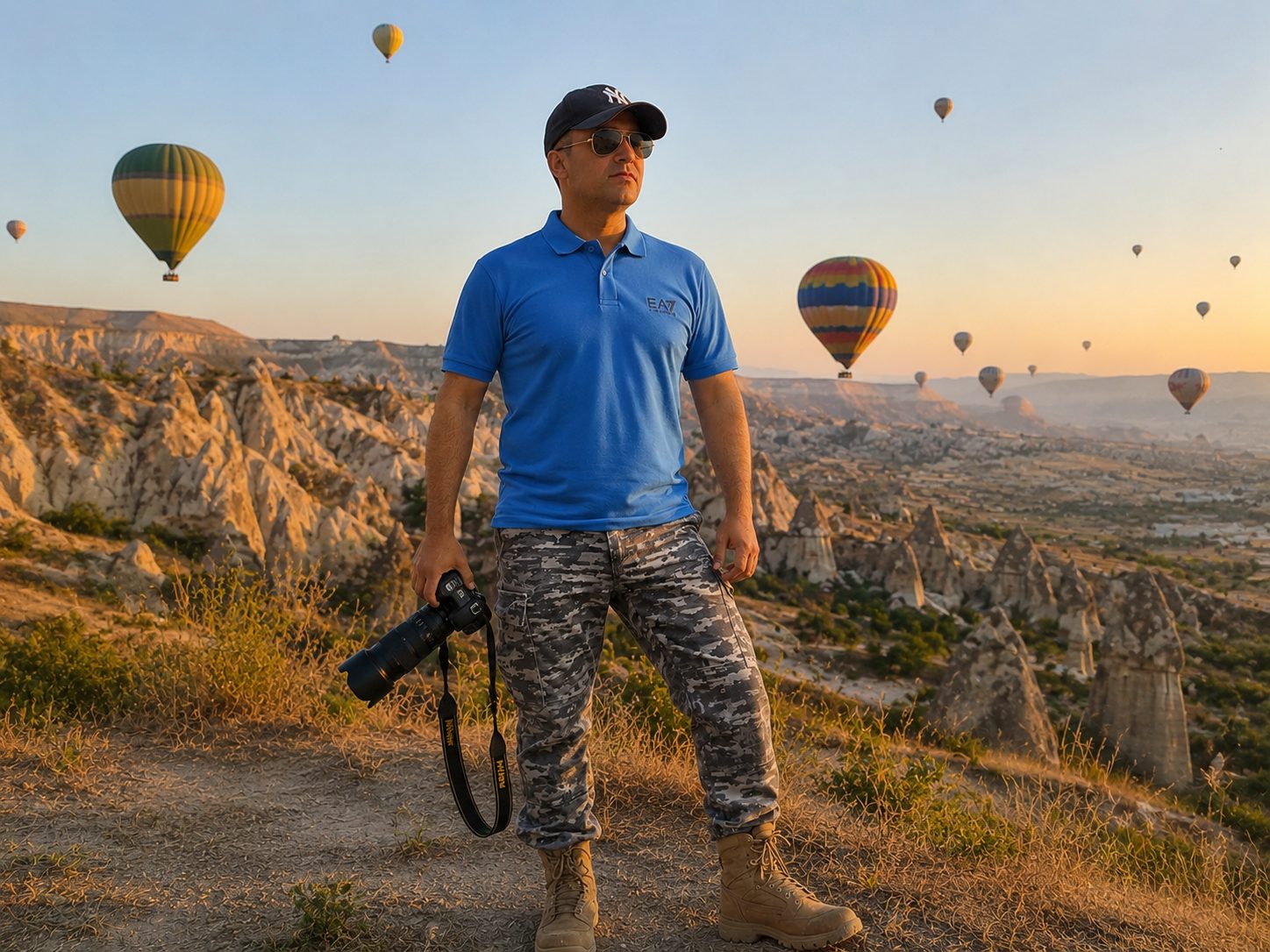
You know the one. A hundred balloons over eroded rock at dawn, shot from a terrace in Göreme, reposted until the image became more famous than the place.
It does not show the permit.
Every balloon in that frame flew because an aviation office looked at wind, visibility and flight-area suitability before sunrise and opened the sky. On another morning the same office closes it. Nobody flies.
The landscape is ancient. The industry above it is roughly fifteen years old, and somebody designed it.
That is the part I want to write about, because almost nobody does. Cappadocia tourism did not grow because the valleys became more beautiful. It grew because Türkiye built institutions around a rural province and kept them running.
What the numbers actually say
Start with the count. Cappadocia’s museums and archaeological sites recorded 4,523,275 visitors in 2025, against 4,374,019 the year before.
The beds matter more than the visitors. The region holds 883 licensed accommodation establishments, 15,688 rooms and 32,037 beds. Those beds took 2,020,619 guests over the year.
The figures come from the Ministry of Culture and Tourism, released by the Governor of Nevşehir in February 2026.
Where the 4.5 million actually go
Now hold that against the map. Nevşehir is landlocked. No coastline, no major city, no airport of its own scale — visitors arrive through Kayseri or Nevşehir Kapadokya.
One open-air museum there received more than 1.1 million people in a year.
January 2026 brought another 178,948 visitors, in the middle of an Anatolian winter. That is the number I keep coming back to. Seasonality is what usually kills small-region tourism, and somebody worked on it.
A single agency, one national brand
On 15 July 2019 Türkiye established the Türkiye Tourism Promotion and Development Agency, TGA, under the Ministry of Culture and Tourism.
Let me be precise here, because it is easy to overstate. TGA did not invent tourism in Cappadocia. The region had been planned as a conservation and development area for decades — UNESCO’s own file refers to it by that name. What 2019 changed was the machinery: one body, one budget, one international brand.
So the honest formulation is that TGA accelerated and internationalised something already under way. Not that it started it.
Even so, the structural choice matters more than any single campaign. Most countries promote tourism through a department that shifts priorities with every government, competing with regional boards that have their own budgets and their own slogans.
Türkiye put national promotion in one place and told it to build a brand.
The rebranding of the country’s international name to Türkiye, formalised at the United Nations in 2022, belongs to the same logic. Whatever anyone thinks of the decision, it was a brand decision, taken at state level, executed across every ministry at once. Very few tourism authorities can do that.
For a province like Nevşehir the effect is straightforward: a rural region with a strong asset gets placed inside a national campaign it could never have afforded on its own, in markets it could never have reached alone.
Turning a spectacle into a regulated industry
Here is the part that gets missed, and it is the most transferable lesson in the whole story.
Ballooning over Cappadocia is not an adventure activity with a safety briefing attached. It is licensed commercial aviation.
The Directorate General of Civil Aviation, SHGM, sets the framework. Its regional office, SHM Kapadokya, runs the mornings. Passenger insurance is mandatory, balloons face annual airworthiness inspection, pilots hold commercial licences.
Since 2013 the airspace has been split into three sectors with a ceiling on daily flights. Reported figures put that ceiling at 154 flights and the operator count at around thirty — I have not been able to confirm either against an SHGM document, so read them as reported, not established.
What is documented is the outcome. Turkish balloon tourism carried a record 933,195 passengers in 2024, up 25 per cent on 2023, across 43,283 flights at seven sites. Cappadocia is by far the largest of them.
The cap looks like a brake. I think it is the reason the industry exists at scale.
Limited daily supply holds prices up, keeps the sky photogenic instead of chaotic, and keeps the operation inside a safety envelope the regulator can actually police. I am not presenting those three effects as measured: I have found no study that isolates them. It is the pattern I have seen in other regulated attractions, and I could be wrong about the weight of each.
What I will say plainly is the counterfactual. An unregulated version of this would eventually have produced a disaster, a suspension and years of lost bookings. Other destinations have run that experiment for us.
Weather cancellations are the visible cost. Flights are refused often, and travellers are told to allow two or three mornings. That inconvenience is itself a design decision: the authority protects the product by being willing to ground it.
What the regulated sky looks like
Three vertical sequences filmed on location in Cappadocia. Every flight visible in them left the ground under the daily clearance described above.
Disclosure: this footage was filmed by Euro News Agency in Türkiye under a commercial production contract with the DERTOUR Group. The contract covered production work only and has no bearing on the analysis on this page.
The quiet work: spreading the market
Look at where Cappadocia’s international visitors came from in 2025: China, Spain, the United States, South Korea, Italy, Japan, Taiwan, Russia, Germany and Brazil.
That list is the least glamorous thing in this article. It is probably the most valuable.
You do not get a list like that by accident. Four of the top ten are East Asian. One is Latin American. The European share sits across three countries instead of one.
A destination built that way is insulated. A currency collapse, a diplomatic row or one bad summer in a single market cannot take the season down with it.
Compare it with the Mediterranean resort model, where a region leans on two or three source countries and finds out how exposed it is only when one of them stops coming.
Three things Türkiye did that most countries do not
Centralised the brand
One national agency with its own funding, rather than provinces competing with separate budgets and contradictory messages.
Regulated the attraction
The signature experience was placed under civil aviation law, with licensing, caps and daily go or no-go authority.
Diversified deliberately
Promotion pushed into East Asian and Latin American markets years before the arrivals showed up in the statistics.
What a small region can actually copy
I have reported from more than 107 countries since 1998, and I have watched a lot of regions try to become the next Cappadocia.
Most of them start at the wrong end. They commission a film, buy advertising, wait, then decide tourism marketing does not work. The film is usually fine. It is the sequence that is wrong, and we have written about what aerial footage can and cannot do for a destination.
Here the order ran the other way. Governance, licensing, capacity and safety first. Promotion amplified something that could already receive visitors.
Thirty-two thousand beds did not appear because a campaign was beautiful. The campaign worked because there were beds.
So what would I tell you to copy? The sequence, and it is unromantic. Decide who governs the site. License the signature experience properly. Build capacity. Fix the off-season. Choose three or four distant markets. Only then spend on media.
Skip a step and you get a viral valley with nowhere to sleep and no rules. That is not tourism. That is a crowd.
What you cannot copy is the asset. Cappadocia had rock-cut churches, underground cities and a landscape with no equivalent anywhere. Institutions multiply an asset. They do not invent one.
And what it inherits along with the growth
Then comes the second problem. Occupancy above ninety per cent in holiday periods. More than four and a half million visitors a year into a small province. An image reproduced so widely that the place risks being consumed as one photograph instead of visited as a region.
This is not my opinion. UNESCO’s own listing for Göreme National Park states that the rock-hewn churches and related structures are at risk of being undermined by erosion and other natural processes coupled with mass tourism and development pressures, and that they can never be replaced.
Turkish authorities appear to agree. In 2025 they introduced a package of measures against overtourism in the region — tighter control of tour activities and reinforced visitor rules — citing illegal construction, environmental degradation and damage to archaeological sites.
Europe’s most visited cities are already spending public money managing some of the pressures that come with tourism concentration, as we set out in our analysis of why destination storytelling needs slow context. The mechanisms differ from city to city, and Cappadocia’s are not Barcelona’s.
But four and a half million visitors in a province this size is a management question, not a marketing one.
Which brings the story back to where it started. Cappadocia’s growth was engineered. The next phase will have to be engineered too, and it will be harder — because limiting something is never as popular as promoting it.
FAQ
Why did tourism in Cappadocia grow so fast?
Through organisation rather than discovery: a national promotion agency created in 2019, the signature balloon experience regulated as commercial aviation, accommodation capacity built to more than 32,000 beds, and promotion deliberately spread across distant markets in East Asia and Latin America.
How many people visit Cappadocia each year?
Museums and archaeological sites in the region recorded 4,523,275 visitors in 2025, up from 4,374,019 in 2024, according to Ministry of Culture and Tourism figures. Licensed accommodation hosted 2,020,619 guests in the same year.
Who regulates the hot air balloons in Cappadocia?
The Turkish Directorate General of Civil Aviation (SHGM) and its regional office SHM Kapadokya. Licensed operators fly only under daily clearance based on wind and visibility, with mandatory passenger insurance, annual airworthiness checks and a capped number of flights per day.
What is TGA?
The Türkiye Tourism Promotion and Development Agency, established on 15 July 2019 under the Ministry of Culture and Tourism, responsible for national tourism promotion, marketing and destination development.
Can another region repeat what Cappadocia did?
The sequence can be repeated; the asset cannot. Governance, licensing, capacity and off-season demand have to be built before promotion, not after. Marketing multiplies whatever already works — it does not substitute for it.
Sources
- Cappadocia visitor figures, accommodation capacity and source-market ranking for 2024 and 2025: Ministry of Culture and Tourism data, released by the Governor of Nevşehir in February 2026 and reported by Türkiye Today from Anadolu Agency. We have cited the reporting chain we actually used rather than a ministry document we did not consult.
- Türkiye Tourism Promotion and Development Agency (TGA), established 15 July 2019 under the Ministry of Culture and Tourism. tga.gov.tr.
- Balloon passenger record for 2024 — 933,195 passengers across 43,283 flights at seven sites, up 25% on 2023 — published by the Directorate General of Civil Aviation (SHGM) under the Ministry of Transport and Infrastructure, reported April 2025. The three-sector airspace division, the daily flight ceiling of 154 and the operator count of roughly thirty circulate widely but are not confirmed here against a primary SHGM document; they are marked in the text as reported.
- 2025 measures against overtourism in Cappadocia, including tighter control of tour activities: Hürriyet Daily News.
- UNESCO, Göreme National Park and the Rock Sites of Cappadocia — World Heritage listing, conservation status and the reference to the Cappadocia Cultural and Tourism Conservation and Development Area.
Figures verified 31 August 2026. Visitor statistics and aviation rules are updated annually; check the original source before republishing.